Suryanarayana C Pointer 笔记
指针是C和C++编程中的一个基本概念。指针是一种变量,它存储了另一个变量的内存地址。通过指针,可以间接访问和操作变量的值。指针的声明通常使用星号(*)符号,例如`int *p;`,这声明了一个指向整数的指针`p`。 指针可以用于动态内存分配,函数参数传递,返回多个值等场景。指针运算包括指针的加减法、比较等。指针也可以作为函数参数,允许函数修改外部变量的值。 此外,指针还可以用于实现函数指针,函数指针是指向函数的指针,可以用来调用函数。函数指针的声明通常使用括号和星号,例如`void (*fp)(int, char);`,这声明了一个指向函数的指针`fp`,该函数的返回类型为`void`,参数类型为`int`和`char`。 在内存管理中,指针也扮演着重要的角色。堆栈(Stack)和
视频入口: https://www.bilibili.com/video/BV1bo4y1Z7xf
Initialization
<data type> *<variable name>;: The pointer to the <data type> of <variable name>
& (ampersand)
&<variable>: Return the address of the variable
* (asterisk)
*<variable>: Return the value at variable's address
To access the address of the variable in format
The asterisk meaning between int* p and *p are not the same.
int* is a type that a pointer point to a data of int type.
*p is to dereference the address which stored in variable p.
Pointer arithmetic
Void Pointer - Generic Pointer
void* <variable name>;
It can't be used to print the value that it points.
It can be used to print itself address.
Char Array
char c[] = "ABC";: It will be stored in the space for array (Stack).
const char* c = "Hello";: It will be stored as compile time constant, so it cannot be modified (Like: c[0] = 'a')
Array & Pointer
The relationship between Array & Pointer.
arr[x]<==>*(arr+x)(You need to know that
arris a const variable, so it cannot be assigned (Like:arr = var)It just the same as the relationship between Reference & Pointer
int &a = var<==>int* const a = &var
return a<==>return *a
The array in function parameters
Most of the time, return result is 1 (Depend on the platfrom)
Because the declaration of
int arr[]is actually a int pointer which points to the first address of the array.Compiler translates
int arr[]=>int* arrSo the variable of
arr's size is the size of pointer.The purpose is to reduce the time and space cost.(It don't need to copy the array)
mulit-dimensional array
2-dimensional array:
a[i][j]=>*(a[i]+j)=>*(*(a+i)+j)
a's type:int (*)[]
a[i]'s type:int*
3-dimensional array:
a[i][j][k]=>*(a[i][j] + k)=>*(*(a[i] + j ) + k )=>*(*(*(a + i) + j ) + k
a's type:int(*)[][]
a[i]'s type:int(*)[]
a[i][j]'s type:int*
Diffence between array type and pointer type
Yes! They are not the same type.
You can't consider them as the same type!
This circumstance only happens in static creation!
p and *p's output are both equal
Differences:
p: It's a one-dimensional pointer;
*p: It's a int* pointer.
Explanation
type of array inequals to pointer
In the other word, array is a special pointer.
What is the point of defining this?
It's a fake-pointer (pointer's address = the address it's point to)
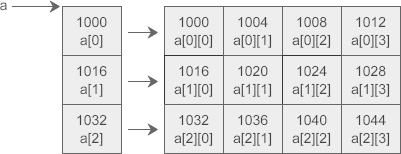
Because the static array is continuous.
But dynamic multi-dimension array is not continuous from row to row.It needs each row's capacity.
For example:sizeof(int[3]) = 12
As we all know,sizeof(int) * 3 = 12 bytes
So when you do operator like+, C can know plus 1 equal to how many bytes
Much deeper understanding
Static:
Dynamic:
It doesn't need [] type for helping.
Because it's structure is different from static array.
It's discontinuous, and is similar to deque in STL:
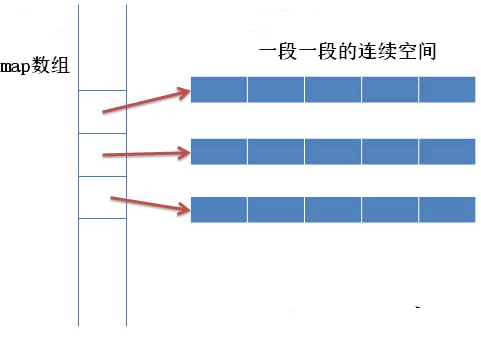
一段一段的连续空间's beginning address are different.

Data in memory
High Bit & Low Bit
注意高字节在左边,低字节在右边
Byte Order(Endian): Big Endian(大端) & Small Endian(小端)
这地方我觉得杨老师在哪一节课上提到过 unix模式 与 微软模式
大概就是 大端 与 小端 序
windows是小端序,unix我就不清楚了
0b1001111
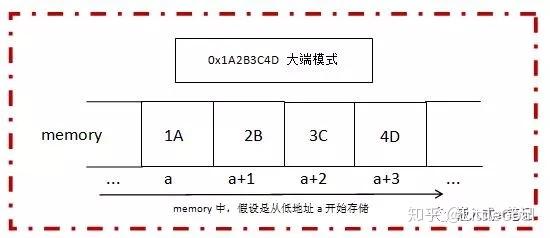
Big Endian
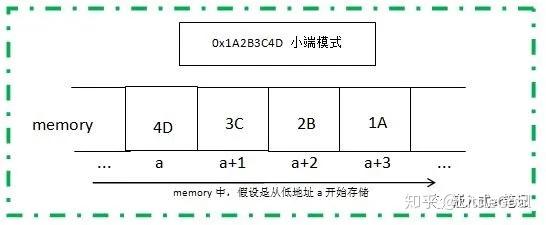
Small Endian

LSB (Least Significant Bit): 最低有效位
0b10010101
The bold underlined bit above called Least Significant Bit
Big Endian: In Big Endian systems, the most significant byte (MSB) is stored at the smallest memory address. So, the most significant byte comes first in memory.
Little Endian: In Little Endian systems, the least significant byte (LSB) is stored at the smallest memory address. So, the least significant byte comes first in memory.